

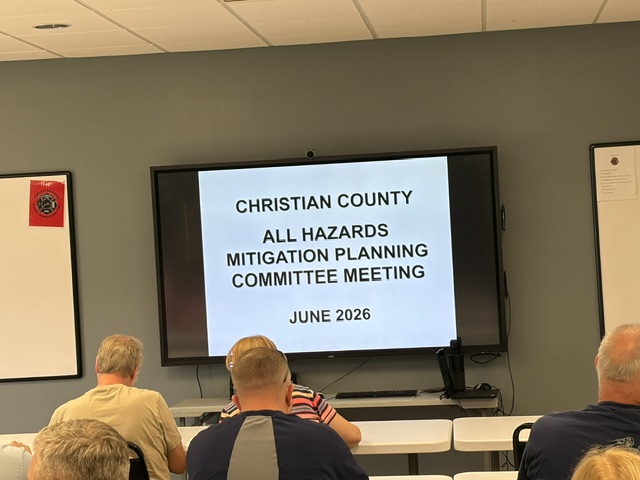
The Christian County Multi-jurisdictional All Hazards Mitigation Planning Committee met on Tuesday to discuss the local counties' tornado vulnerability analysis, results of a recent risk priority index exercise, different community lifelines, and asset vulnerability.
Speaking at Tuesday's informative committee meeting are Emergency Services Management Manager Andrea Campbell alongside of Certified Risk Assessor and Environmental Toxicologist Ken Runkle from Creek Run LLC, an environmental engineering corporation.
Ken Runkle goes over what a tornado vulnerability analysis is, and why it helps in mitigating risks. According to Runkle, this analysis is when an estimate is done on what future damages may occur from a particular hazard. When trying to assess how damaging a tornado would be in your community, Runkle states, that it all boils down to the average tornado size, and the size and number of buildings present within that jurisdiction.
Andrea Campbell then explains the risk priority index exercise results. The results come following the exercise sheets that several entities filled out during the last meeting. Campbell explains that this is a quantitative measure to ranking the hazards. The ranking assesses which hazards are the highest risk by three categories which are frequency of the hazard, impacts to life and health, and impacts to life and infrastructure.
Runkle explains what community lifelines are and why they are important to Hazard Mitigation. Community lifelines are identified by FEMA as crucial to the functionality and safety of the community and its residents. Some of those life lines include transportation, communications, water, and energy grids.
Campbell then has the attending entities fill out an asset vulnerability survey to assist with hazard mitigation. These specific surveys are done to determine what the vulnerability of each participating jurisdiction is to each identified hazard. FEMA requires a summary of key issues or problem statements and the effects that each hazard has for the jurisdictions or their assets, in order to approve of any sort of grant or for their projects to be able to move forward.
Runkle then explains what prioritization methodology is. Runkle says that prioritization methodology is a tool for assisting different jurisdictions and entities in finding out what the most important project is and the level of priority.
The final thing on the agenda is the mitigation action tables. Campbell explains, these mitigation action tables are there to help prioritize and put action to projects. Campbell also explains that in the case of state or government grants, FEMA requires these to be filled out. Campbell also explains the different categories of what can and cant be approved by FEMA for a grant to complete needed projects.
The next meeting is scheduled for 08/25/2026 at 2PM, Information on Creek Run LLC can be found at creekrun.com.
Find out details after the next meeting at taylorvilledailynews.com.