By John Kruzel
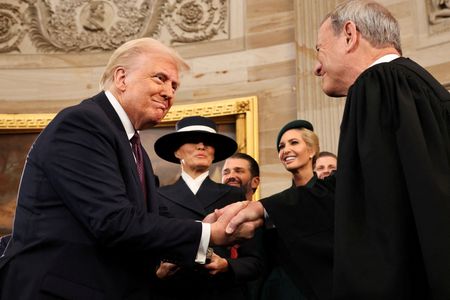
WASHINGTON, July 4 (Reuters) – U.S. Chief Justice John Roberts and President Donald Trump could hardly be more different personally, but each prevailed during the Supreme Court’s most recent term when their interests aligned.
The mutual benefits of the dynamic between Roberts, a mild-mannered Midwestern institutionalist, and Trump, an audacious billionaire New York real estate developer, were on display when the court issued several major rulings favoring the president during its eventful nine-month term that ended on Tuesday.
Among those was a decision, authored by Roberts, that gave Trump broad authority to fire regulatory agency heads, capping a decades-long conservative push to strengthen the president’s grip on key levers of government power.
Overall, the court has been highly deferential to Trump in his second term in office, as he has pushed to expand his powers in domestic affairs and foreign policy, drawing numerous legal challenges.
Yet the court’s term also brought into sharper focus the differences between Roberts and Trump. In three major cases where their alignment on issues broke down, Trump was handed stinging defeats. Roberts penned each of these rulings.
The trio of Trump losses, which were joined by a different lineup of justices but backed in each case by the court’s three liberals, dealt Trump big setbacks on tariffs, birthright citizenship and his unprecedented bid to fire a member of the Federal Reserve Board of Governors.
John Yoo, a professor at the University of California, Berkeley School of Law, said these rebukes should put to rest the idea that the court is merely “an arm of the Trump agenda.”
“This term shows that Trump wins at the court only when his agenda coincides with Roberts’ agenda,” said Yoo, who served as a Justice Department lawyer under Republican President George W. Bush.
MOVING RIGHTWARD
Roberts has served as chief justice for two decades, and with four different presidents in the White House — two Democrats and two Republicans. For most of that time, the Roberts Court had a 5-4 conservative majority, with former Justice Anthony Kennedy serving as a “swing vote.”
Things changed dramatically with Trump’s appointment during his first term of three justices — Neil Gorsuch in 2017, Brett Kavanaugh in 2018 and Amy Coney Barrett in 2020.
With the resulting conservative supermajority provided by Trump, the Roberts Court has moved American law dramatically to the right this decade. This has included rulings that have rolled back abortion rights and affirmative action policies, expanded gun and religious rights, limited the authority of regulatory agencies, and more.
And the court continued that trend during its latest term.
In two pro-Republican rulings, it gutted a key provision of the Voting Rights Act in April and struck down a campaign funding restriction on Tuesday, advancing long-held aims of the Roberts Court.
According to Syracuse University College of Law professor Jenny Breen, the court’s continued erosion of the Voting Rights Act marked “a decades-long project for Chief Justice Roberts.”
The 6-3 Voting Rights Act ruling, powered by the conservative justices and authored by Justice Samuel Alito, made it harder for minorities to challenge electoral maps as racially discriminatory under that historic 1965 civil rights law.
The ruling opened the door for Republican-led Southern states to dismantle Democratic-held majority-Black and majority-Latino districts ahead of the November midterm elections. Black and Latino voters tend to support Democratic candidates. Trump’s fellow Republicans seek to retain control of Congress in the November midterm elections.
As major Republican committees head toward the November midterm elections with a significant cash advantage over their Democratic counterparts, Trump’s party gained another boost from the Supreme Court. As it has done in other campaign finance rulings, the Roberts Court struck down funding limits in a ruling on Tuesday rejecting federal restrictions on coordinated spending between political parties and their candidates, citing free speech grounds.
PRESIDENTIAL POWER
Perhaps the ruling that earned Roberts the most praise from conservative legal minds and Trump supporters alike was one that, according to some legal analysts, boosted presidential power under the U.S. Constitution more than any prior ruling in the Supreme Court’s history.
Monday’s 6-3 decision authored by Roberts in a case called Trump v. Slaughter overturned the court’s 1935 precedent that had recognized the authority of Congress to protect leaders of independent regulatory agencies from presidential removal at will. By freeing Trump to fire these officials in a ruling involving his ouster of Federal Trade Commission member Rebecca Slaughter, the court consolidated the president’s authority over the executive branch.
“His best work has come when the limits of the executive branch have been tested by Trump’s adversaries,” Robert Luther III, a George Mason University law professor who worked in the White House Counsel’s Office during Trump’s first term, said of Roberts.
The Slaughter decision is seen as the high-water mark for the “unitary executive” theory, a conservative legal doctrine popularized during the presidency of Republican Ronald Reagan in the 1980s that had made steady inroads with like-minded justices. That theory sees the president as having sole authority over the U.S. government’s executive branch, including the power to fire and replace heads of federal agencies at will.
According to American University Washington College of Law professor Elizabeth Beske, the ascendancy of the unitary executive is “part of a decades-long John Roberts project.”
“Roberts has always been a unitary executive guy, since his days in the White House Counsel’s office” during Reagan’s presidency, Beske said.
“There have been a lot of scholarly headwinds in the past few years against the moves taken in Slaughter,” Beske said of the ruling, “but I think he set out to do it long ago and could not be stopped.”
ECONOMIC AGENDA
Among Trump’s major defeats this term were two rulings that blew a hole in his economic agenda.
In a 6-3 decision by Roberts in February, the court struck down Trump’s sweeping global tariffs that he pursued under a law meant for use in national emergencies. In another ruling written by Roberts, the court on Monday refused to let Trump fire the Fed’s Lisa Cook, standing firm to preserve central bank independence.
“Both of those decisions reflect the Supreme Court’s discomfort with changes that they fear might disrupt the market or economy more broadly,” Breen said. “Those decisions, in other words, are entirely consistent with the conservative economic orientation of the court.”
On the final day of its term, the court, in another Roberts-penned ruling, found that Trump’s executive order seeking to deny birthright citizenship to the children of certain immigrants violated language in the Constitution’s 14th Amendment that confers citizenship to those born in the United States who are “subject to the jurisdiction thereof.”
Yoo noted that Trump’s effort to overrule birthright citizenship had sought to overturn “an uninterrupted history of following that rule,” plus a prior ruling in an 1898 case called United States v. Wong Kim Ark.
“Where Trump seeks outcomes because of their political salience, but he comes into conflict with these long-held Roberts Court principles, he has lost,” Yoo said.
(Reporting by John Kruzel; Editing by Will Dunham)
Brought to you by www.srnnews.com