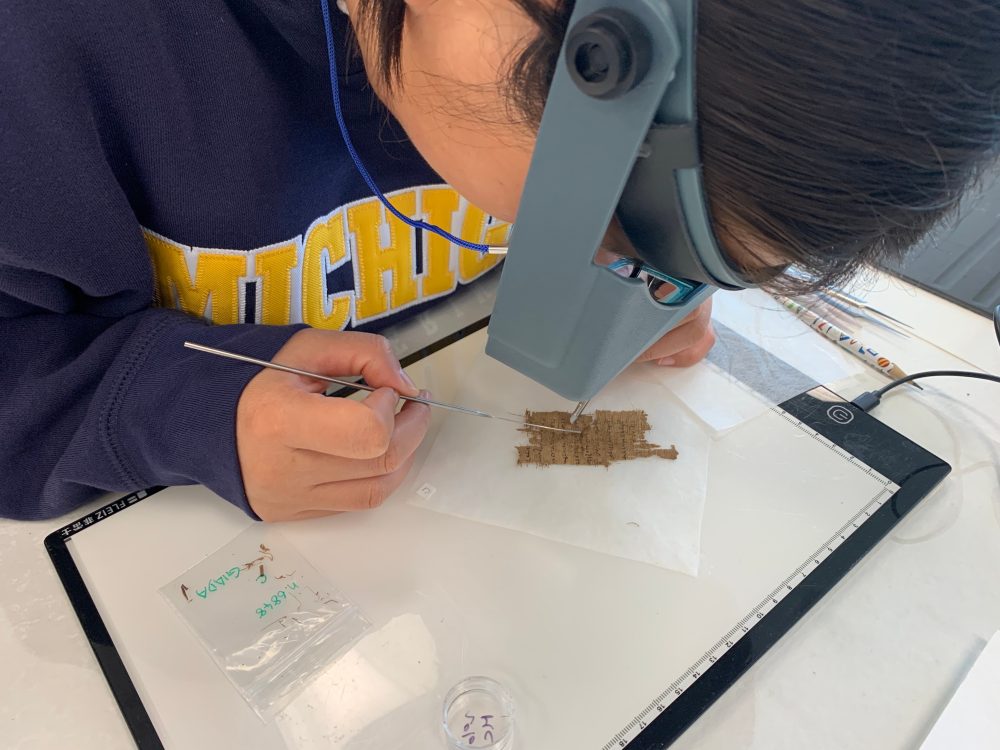
ANN ARBOR, Mich. (AP) — Shijin Jiang pulled the precision binocular headband magnifier over her eyes and hunched down within a few inches of the ancient text resting on a light board.
Using a pair of hand tools, Shijin carefully inspected the sheet made from the papyrus plant, proceeding with the utmost care. After all, it most likely hadn’t been handled in a century — nor read for thousands of years.
The Papyrus Conservation Summer Seminar at the University of Michigan is the only one of its kind in the Americas, according to the university. And it’s one of the few in the world designed to convey the best practices for conserving papyrus manuscripts, ancient texts written on rolls or sheets made from the papyrus plant.
“If you touch this papyrus, you can feel the history,” said Shijin, a native of China who was among nine scholars from across the globe, including Ireland, Italy and the U.S., who took the 10-day course.
Michigan’s Papyrology Collection covers texts and documents from 1000 B.C.E. to 1000 C.E. No institution on this side of the world has more of them, the Ann Arbor school said, giving the researchers access to a vast collection of ancient papyri. There are portions of the Homer epics, “The Odyssey” and “The Iliad,” writings by the philosopher Epicurus and the oldest-known copy of the Epistles of Paul.
“Carrying on this tradition is an incredible responsibility, but it also is incredibly fun and rewarding, because there’s nothing I love more than getting people together from all over the world, sharing ideas, learning from each other,” said Marieka Kaye, who manages library preservation services for physical collections at the University of Michigan Library.
Kaye said she tried to make “things comfortable and not scary, because a lot of people just feel terrified working on these ancient things.”
The seminar introduced the papyrologists and conservators to techniques in the treatment, storage and care of the ancient texts, as well as documentation practices. Papyrus and its ink can crumble, smear or break, so Kaye encouraged the students to carefully remove dirt, sand, salt and debris; use controlled moisture to soften folds and realign fibers; and dry the papyrus slowly under light weight to prevent curling.
The first seminar was held in 2012, and they have been held every two years since, except for the 2020 pandemic year. About 50 students total have taken part.
“If we don’t train the next generations of conservators, this is a craft that is going to be lost,” said Giuliano Sidro, curator of Michigan’s Papyrology Collection.
Michigan has so many papyrus manuscripts on hand that its researchers haven’t gone through them all. Some of the items were acquired, while others were excavated, during university expeditions to the ancient site of Karanis, Egypt, from 1924-35. Francis Willey Kelsey, a Latin professor who died in 1927, was the driving force behind the establishment of the Papyrology Collection. He believed Michigan students studying the ancient world needed access not only to books, but to the tangible remains of antiquity. Today, the Kelsey Museum of Archaeology is a fixture on the Michigan campus. Its collection represents one of the finest compilations of daily-life objects from Greco-Roman Egypt located outside of Cairo.
“This is a place where you make discoveries, potentially every day, if you just go into the vault, pick out a box and open something up, and you start reading,” Sidro said.
Of course, to make sense of it, one needs to be able to decipher Arabic, ancient Greek or Latin, and even Egyptian, one of the earliest known written languages that is now extinct. A few of the seminar participants were able to read the papyri, including Arzak Mohamed, who reads Arabic, and Mauro Castiello, a papyrology doctoral student in Milan, who can translate ancient Greek and Latin.
Kaye said she always tries to include a student from Egypt among the seminar participants.
Mohamed, a postdoctoral fellow at Macquarie University in Sydney, had heard about the papyrus seminar for years and always wanted to attend. The 42-year-old mother of three is from Fayoum, Egypt, not far from Karanis.
“Now, I can transfer this information from Michigan to Egypt and even in Australia,” she said. “I will be like the chain, connecting between the three countries.”
“By saving this information, we can transfer the knowledge to the next generation,” she added.
Brought to you by www.srnnews.com