By Michael S. Derby
April 21 (Reuters) – Federal Reserve chief nominee Kevin Warsh came under fire from Senate Democrats Tuesday over his plans to divest tens of millions of dollars in financial assets if confirmed to lead the U.S. central bank, amid questions about who would potentially buy those assets and the conflicts that could arise from those transactions.
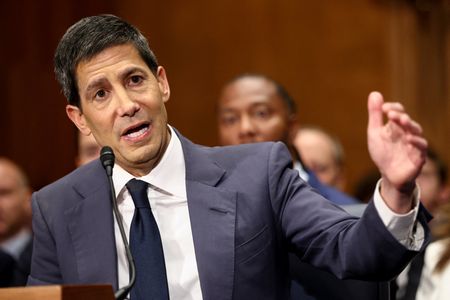
“So that there’s no question about my independence, no question about the clarity of my financial record, I agreed to divest virtually all of my financial assets, the large majority of which will be divested” before taking office, Warsh said during his confirmation hearing before the Senate Banking Committee.
Warsh added that he had gone “above and beyond” what was required on the asset divestment plan for no other reason than that “the Fed needs to re-establish its credibility.”
Democratic Senator Elizabeth Warren challenged Warsh about what he plans to sell and how he plans to sell it and who or what might buy the holdings. Her line of questioning follows the release of financial disclosure documents filed by Warsh that showed massive wealth in a variety of investments, much of which is incompatible with Fed rules that govern what officials can hold.
“Will you at least disclose how you plan to disclose and divest these secret assets,” Warren asked. “I’m sure you understand that the public might question your motives if, for example, billionaire Stanley Druckenmiller, who you honored in your opening statement, and who makes a living guessing what the Fed will do next, cuts you a massive check for $100 million as you take the oath of office to become the new Federal Reserve chair,” the legislator said.
Warsh declined to offer details about how he would manage the logistics of his divestiture pledge except to say his plan for unloading his holdings was approved by government ethics officers. The 56-year-old lawyer and financier also declined to say what many of his assets were after his financial disclosure forms had noted he was ` by secrecy agreements for some of his holdings.
While Warren led most of the questions about the nominee’s wealth, a number of other Democrats on the committee raised similar issues.
WARSH WOULD BE THE WEALTHIEST FED CHAIR
Warsh, who served on the Fed’s Board of Governors from 2006 to 2011, rejected the idea that he had not made his holdings fully public, saying “I’ve shared all information about assets that I control and that I can share,” which met the “satisfaction” of the U.S. Office of Government Ethics.
Warsh noted that selling his holdings comes with challenges. He said that when that process was completed, he would have “virtually no financial assets” and “we’ll be sitting in something like cash.” Warsh’s financial disclosures show a net worth of at least $100 million and he is married to an heir of the Lauder family, which is worth billions.
Warren, however, questioned him about the divestment plan. “Do we have any way to verify that, in fact, these sales will occur if we have no idea what’s in them?” she asked.
Documentation used by the government to detail financial transactions by officials only notes what assets were sold, for how much, and when the transaction takes place. It does not communicate who the purchaser is, which means any additional details would likely have to be revealed by Warsh.
Warsh’s pledge to bring his vast wealth in line with the Fed’s ethics rules comes as the central bank has faced significant challenges in recent years related to some policymakers’ trading activities. To end the controversy, the Fed significantly tightened the rules governing what top-level policymakers and family members could hold and how they could manage their money.
If Warsh is confirmed, he would be the wealthiest Fed chair in history, with holdings dwarfing those of most Americans.
“I think that Senator Warren is raising important questions about just who is on the other side of these trades that require confidentiality,” in a climate where there have been many questions about the trading and investing activities of top government officials, said Peter Conti-Brown, a Fed historian at the Wharton School of the University of Pennsylvania.
GOP SUPPORT
Senator Thom Tillis, a Republican who has said Warsh will not get a confirmation vote until the Trump administration’s criminal probe of Fed Chair Jerome Powell and a central bank renovation project are ended, defended Warsh after another Democratic senator said it appeared the Fed chief nominee would be out of compliance with central bank ethics rules.
“I thought it felt like a cheap shot to say, he’s out of compliance when in fact he’s not,” Tillis said.
Tillis, however, repeated that Warsh’s confirmation would be delayed as long as the probe of Powell was ongoing.
(Reporting by Michael S. Derby; Editing by Paul Simao)
Brought to you by www.srnnews.com