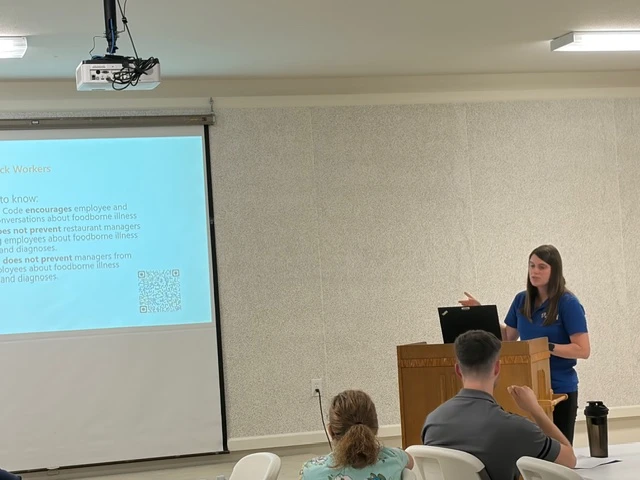
Local eateries refresh food safety knowledge at The Christian County Health Department’s (CCHD) 4th annual Food Safety Workshop yesterday. During this workshop, owners and upper-level staff of various local restaurants and establishments that handle food met at the University of Illinois Extension office in Taylorville to learn about different types of emergencies, foodborne illness, and safety procedures.
Director of Environmental Health, Joe Torres, spoke to Hart Media Group at the workshop and said that a big factor in putting these workshops together is that the overwhelming list of rules and regulations that CCHD uses to assess establishments may not be fully known by local restaurant owners. Additionally, some restaurant owners may not be fully aware of certain illnesses or what to do in the event of an emergency.
One of the biggest lessons was on what the CCHD calls the “Big Six.” The Big Six is made up of the six foodborne illnesses that restaurants typically see. The illnesses that make up the Big Six are Shiga toxin-producing E. coli (STEC), nontyphoidal Salmonella, Salmonella Typhi, Shigella, Hepatitis A, and Norovirus.
Also discussed was what to do in the event of an emergency. It was, of course, recommended to always keep an emergency policies and procedures manual for such situations. Having this prepares your business to handle situations with on-duty staff in the event that you, as the manager or owner, are absent.
The types of emergencies a restaurant or food service establishment could potentially encounter include boil orders, floods, medical emergencies, power outages, and fires.
Some emergencies may cause you to fully close until further notice or require you to limit your operations. Examples of limited operations would be an emergency menu with recipes that don’t require the use of water while under an active boil order. Or, there could be a plumbing leak that floods a portion of the kitchen or freezer, causing you to close until the area is dried and completely cleaned.
Christian County Health Administrator Dr. Chad Anderson said how important it is to keep food safety knowledge up to date and that the CCHD will always be dedicated and committed to assisting our local restaurants grow and maintain knowledge. Dr. Anderson also said that the CCHD will forever be committed to being an educational resource.
For more information on the CCHD, go online to www.cchdil.org
.